Understanding the New Approach to Risks and Opportunities
Small manufacturers and service businesses can use the updated requirements to improve quality.
They can also reduce uncertainty and drive business improvement.
The ISO 9001 revision, published in September 2026, marks a major update to the world’s best-known QMS standard. While the core principles of ISO 9001 stay the same, the revised standard adds updates.
These updates make quality management more relevant to today’s business world.
One of the most meaningful changes involves how organizations identify, evaluate, and address risks and opportunities.
Under ISO 9001:2015, Clause 6.1 addresses risks and opportunities together. The 2026 revision draws a clearer line between the two concepts. It encourages businesses to think separately about what could go wrong. It also encourages them to think about what could go better.
For small manufacturers, machine shops, engineering firms, and service providers, this distinction is practical. It helps them improve their quality systems. It does so without adding unnecessary complexity.
What’s Changing with Risks and Opportunities in ISO 9001:2026?
The 2015 version of ISO 9001 introduced risk-based thinking as a fundamental part of quality management. Organizations were expected to consider risks and opportunities that could affect their ability to deliver conforming products and services, meet customer requirements, and achieve intended QMS results.
However, many businesses interpreted the requirements primarily as a need to identify and mitigate risks.
As a result, people sometimes overlooked opportunities or simply treated them as the opposite of risks.
ISO 9001:2026 places greater emphasis on distinguishing risks from opportunities within the planning process.
The updated approach helps organizations recognize that managing uncertainty and pursuing improvements are related but different business activities.
Understanding the Difference
Risks: What could negatively affect our business?
Risks involve uncertainty that could prevent an organization from achieving its quality objectives, satisfying customers, or delivering consistent products and services.
Examples include equipment failures, supplier disruptions, employee turnover, cybersecurity incidents, and production errors.
Opportunities: What could help our business perform better?
Opportunities involve potential improvements that could strengthen business performance, increase customer satisfaction, improve efficiency, or support growth.
Examples include adopting new technology, expanding employee skills, improving processes, reducing waste, and developing new services.
The distinction matters because an organization can manage risks well and still miss valuable opportunities to improve operations.
ISO 9001:2026 Clause 6.1: Planning for Risks and Opportunities
Clause 6.1 remains central to risk-based thinking in the ISO 9001 quality management framework.
The revised approach provides clearer treatment of risks and opportunities, helping organizations plan actions appropriate to each.
When assessing risks, businesses should think about what could go wrong.
They should consider how likely each outcome is, how serious the impact could be, and they should also plan steps to prevent problems or reduce harm.
When evaluating opportunities, organizations should consider potential benefits, feasibility, available resources, and how an improvement could contribute to their quality objectives.
This does not mean businesses need to develop two complicated management systems or create extensive new documentation.
Instead, they should be able to demonstrate that they have thoughtfully considered both risks and opportunities and integrated appropriate actions into their existing business processes.
Examples of Risks and Opportunities for Small Manufacturers
For manufacturers, including CNC machine shops, metal fabricators, plastics manufacturers, and aerospace suppliers, risks and opportunities often arise from production processes, equipment, employees, suppliers, and customer requirements.
The following examples illustrate how a small manufacturer might address each category.
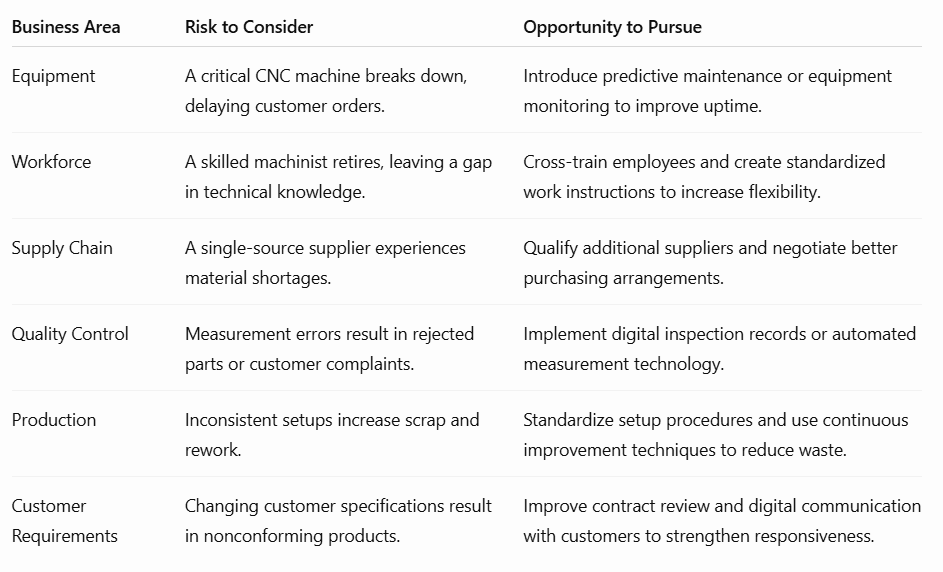
Manufacturing Example: A 20-Employee CNC Machine Shop
Consider a small precision machining company that produces components for aerospace and industrial customers.
Risk identified: The company relies heavily on two experienced machinists who perform complex setups. If either employee leaves or becomes unavailable, production delays and quality problems could result.
Action to address the risk: Management develops documented setup instructions, establishes a cross-training program, and identifies backup personnel for critical production processes.
Opportunity identified: By standardizing setup procedures and improving employee skills, the company could reduce setup times, increase machine utilization, and accept additional customer orders.
Action to pursue the opportunity: The company uses a training matrix. It sets goals to reduce setup time. It tracks progress for six months.
The business has addressed a significant operational risk while also identifying an opportunity to improve productivity and capacity.
This illustrates how the two concepts can complement each other without anyone treating them as identical.
Examples of Risks and Opportunities for Small Service Businesses
Risk-based thinking is equally important for service organizations.
Engineering firms, IT service providers, consulting businesses, calibration laboratories, and professional service companies face quality-related challenges that differ from those of manufacturers.
Their risks and opportunities frequently involve employee expertise, project management, customer communications, information security, and service consistency.
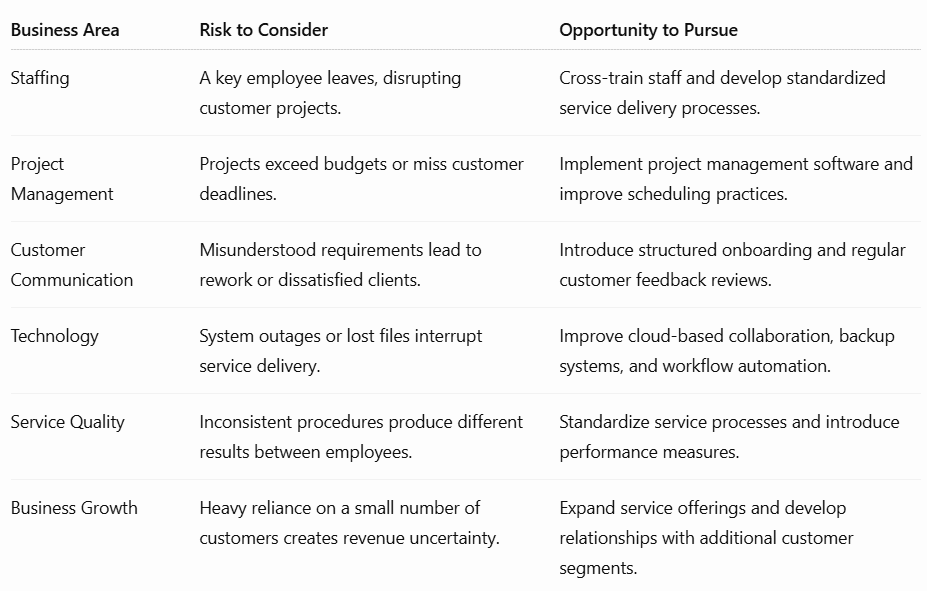
Service Business Example: A 15-Employee Engineering Firm
Consider a small engineering company providing design and technical support services to manufacturing customers.
Identified risk: Team members often share project requirements by email and informal talks. This raises the risk of missed details, repeated work, and project delays.
Action to address the risk: The company adds a formal project intake process. Customer requirements are documented. Approval checkpoints are set before engineering work begins.
Opportunity identified: A more consistent project management process could improve turnaround times, reduce administrative work, and create capacity to serve additional customers.
Action to pursue the opportunity: The company implements a centralized project management platform, standardizes project templates, and measures on-time delivery and customer satisfaction.
By addressing the risk of miscommunication, the company also creates an opportunity to improve service efficiency and profitability.
Do Businesses Need Separate Risk and Opportunity Registers?
One of the most common questions about the ISO 9001:2026 changes is whether organizations will need additional documentation.
ISO 9001 does not generally require a formal risk register or opportunity register simply because risks and opportunities must be addressed.
However, maintaining a straightforward record can help small businesses organize their planning activities and demonstrate how decisions are made.
How Core Business Solutions Can Help with Your ISO 9001:2026 Transition
For small and midsize businesses, transitioning to ISO 9001:2026 should be an opportunity to strengthen the quality management system—not simply update documents to satisfy an auditor.
At Core Business Solutions, we help manufacturers and service organizations understand ISO requirements and implement practical management systems that support their business goals. Reach out to us today at 866-354-0300 for a transition quote or other consulting services.