
What Certified Small Businesses Need to Know About the Transition
ISO 9001:2026 has officially been published, beginning the transition from ISO 9001:2015 to the new edition of the world’s most widely used Quality Management System standard.
Published on September 16, 2026, ISO 9001:2026 is the sixth edition of the standard and replaces ISO 9001:2015 as the current international standard for Quality Management Systems (QMS).
For small businesses already certified to ISO 9001:2015, the most important message is simple: you do not need to rebuild your Quality Management System from scratch.
The new edition builds on the familiar ISO 9001 framework while introducing targeted changes intended to make the standard clearer and more relevant to today’s organizations. ISO describes the revision as providing clearer requirements, a stronger focus on leadership and quality culture, greater clarity around risks and opportunities, expanded Annex A guidance, and closer alignment with other ISO management system standards.
The transition is an opportunity to evaluate your existing QMS, identify the areas affected by the new requirements and make focused improvements before your transition audit.
For small businesses, the key is to start planning early without making the transition more complicated than it needs to be.
ISO 9001:2026 Transition Timeline
The Final Draft International Standard (FDIS) was released for ballot in May 2026 and subsequently received overwhelming international approval. The final standard was scheduled for publication September 16, 2026.
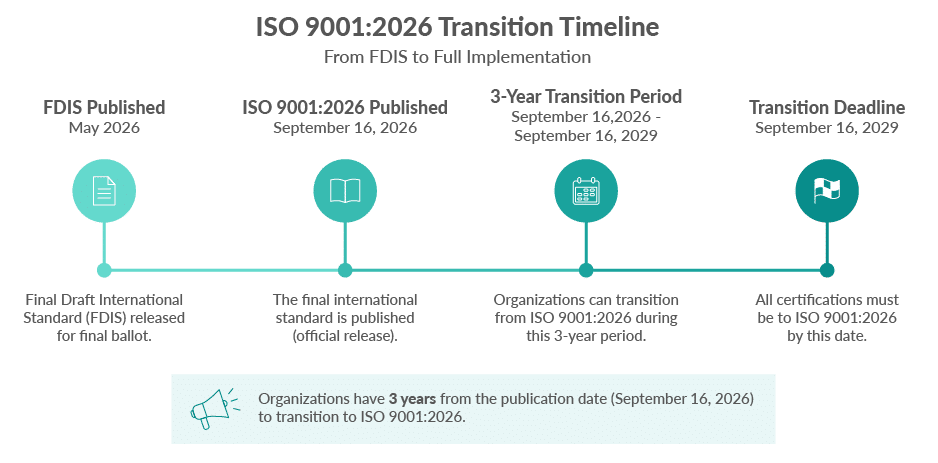
The transition period gives organizations time to understand the changes, update their Quality Management Systems, train employees as necessary, conduct internal audits and prepare for a transition audit.
That does not mean companies should wait until the end of the transition period. For many small businesses, spreading the work over time will be significantly easier than trying to make all necessary changes shortly before a certification deadline.
Is ISO 9001:2026 a Major Change From ISO 9001:2015?
No. For organizations with a mature, functioning ISO 9001:2015 system, the transition should generally be an evolution of the existing QMS rather than a complete overhaul.
The fundamental purpose of ISO 9001 remains the same: helping organizations consistently provide products and services that meet customer and applicable requirements while continually improving their Quality Management System.
ISO says the new edition maintains the trusted framework while making targeted updates for clarity, usability and relevance.
That is particularly important for small businesses. Transitioning to ISO 9001:2026 should not mean creating layers of new procedures, forms and records simply to satisfy an auditor.
Instead, start with what you already have and determine what actually needs to change.
What Changed in ISO 9001:2026?
Several areas deserve particular attention as certified organizations begin their transition.
Greater Emphasis on Quality Culture
ISO 9001:2026 puts greater emphasis on leadership's role in developing and supporting a culture of quality.
For a small business, quality culture does not have to become a formal corporate initiative. It can be demonstrated in how leaders communicate expectations, make decisions, respond to problems and reinforce the importance of meeting customer requirements.
The objective is to make quality part of how the organization operates—not simply something the quality manager prepares for an audit.
Ethical Behavior Receives More Attention
Ethical behavior is also more visible within the revised standard.
Organizations should consider how expectations for ethical conduct relate to areas such as accurate records, customer commitments, product conformity, communication and reporting quality concerns.
Many certified companies may already address these expectations through employee handbooks, codes of conduct, training or established business practices. The transition provides an opportunity to make sure those practices are appropriately connected to the QMS.
Risks and Opportunities Are Clearer
Risk-based thinking remains an important part of ISO 9001, but the 2026 edition provides greater clarity around risks and opportunities. ISO specifically identifies clearer management of risks and opportunities as one of the improvements in the new edition.
This doesn't necessarily mean your company needs a more complicated risk register.
Instead, review whether your processes appropriately identify threats that could affect QMS results while also considering opportunities to improve performance.
An opportunity could include cross-training employees, automating a process, developing an alternate supplier, improving production flow or reducing scrap.
Stronger Attention to Managing Change
Small businesses change constantly. They add customers, replace equipment, implement new software, change suppliers, hire employees and modify processes.
Your QMS should provide a practical way to evaluate significant changes and consider their potential consequences before and after implementation.
For many small organizations, this can be accomplished through a straightforward change-management process rather than a complicated approval system.
Climate Considerations Are Incorporated
The climate-change considerations introduced into ISO management system standards in 2024 are incorporated into the new edition.
Organizations need to consider whether climate change is a relevant issue within their organizational context and whether interested parties have relevant climate-related requirements.
This does not automatically mean an ISO 9001-certified company needs an environmental management program. The organization needs to make a reasonable determination about relevance to its QMS and address applicable issues appropriately.
Organizational Knowledge
Organizational knowledge can be especially important for small businesses, where significant technical or operational knowledge may reside with only one or two experienced employees.
Companies should review how they identify, retain and share knowledge necessary for their processes and QMS.
That might include work instructions, cross-training, employee training, lessons learned, technical documentation or succession planning.
Expanded Annex A Guidance
ISO also highlights a new Annex A intended to clarify key terminology and the intent behind requirements.
This additional guidance can be useful when deciding how a requirement applies to your particular organization.


Already ISO 9001 Certified? Here’s What to Do Next
If your business is currently certified to ISO 9001:2015, you already have most of the foundation needed for ISO 9001:2026.
The goal now should be to determine where your current system differs from the new requirements and address those differences systematically.
A practical small-business transition plan should include:
- Obtain and review ISO 9001:2026. Make sure the people responsible for your QMS understand the final requirements rather than relying on earlier DIS or FDIS documents.
- Conduct an ISO 9001:2026 gap assessment. Compare your existing QMS against the new edition and identify actual gaps.
- Prioritize the changes. Separate meaningful system changes from minor documentation or terminology updates.
- Update your QMS. Revise procedures, processes and documented information where necessary without changing things that already work.
- Train leadership and employees. Focus training on the changes that affect each person's responsibilities rather than retraining everyone on the entire standard.
- Implement and collect evidence. Give updated processes enough time to operate so you can demonstrate that they are effective.
- Conduct an internal audit. Audit against ISO 9001:2026 before your transition certification audit.
- Complete management review. Make sure leadership has reviewed the transition and the effectiveness of the updated QMS.
- Coordinate with your certification body. Determine when your transition audit will occur and how it fits with your existing surveillance or recertification schedule.
When Should Your Company Transition?
There isn't necessarily one ideal transition date for every company.
Some organizations may want to transition early, particularly if major customers begin requesting ISO 9001:2026 certification. Others may find it more efficient to coordinate their transition with an upcoming surveillance or recertification audit.
Your timing should take into account your current certification cycle, customer and contractual requirements, available resources, and the amount of work identified during your gap assessment.
The important thing is to develop a plan rather than simply treating the final deadline as the date to start.
How Core Business Solutions Can Help With Your ISO 9001:2026 Transition
If Core helped your company achieve or maintain ISO 9001 certification, you don't have to navigate the new edition on your own.
Core Business Solutions specializes in helping American small businesses implement and maintain practical Quality Management Systems. Our consultants can work with your existing ISO 9001:2015 system and help you make the changes necessary to prepare for ISO 9001:2026—without unnecessarily rebuilding processes that already work.
Core can assist with:
- ISO 9001:2026 gap assessments
- Transition planning
- QMS documentation updates
- Leadership and employee training
- Internal audits against ISO 9001:2026
- Corrective action and implementation support
- Transition audit preparation
- Ongoing QMS maintenance and support
For companies with limited internal quality resources, Core can also provide hands-on support throughout the transition so the work doesn't fall entirely on one quality manager or business owner.
Start Your ISO 9001:2026 Transition With a Clear Plan
ISO 9001:2026 is here, but certified businesses have time to make the transition thoughtfully.
For most small businesses, the best approach is not to rewrite the entire QMS. Understand what changed, compare the new requirements against what you're already doing, close the meaningful gaps and integrate those changes into your existing system.
Starting early gives your company more flexibility to make improvements at a manageable pace and coordinate the transition with your normal ISO certification activities.
Already certified to ISO 9001:2015? Core Business Solutions can help you determine exactly what needs to change for ISO 9001:2026 and build a practical transition plan around your existing QMS.
Contact Core Business Solutions to discuss your ISO 9001:2026 transition.
About Scott Dawson
Scott has over 25 years of Quality Management System experience as well as ISO 9001 standard development and implementation experience. From 2010-2025, Scott Dawson, President of Core Business Solutions, was an active voting member of the U.S. Technical Advisory Group (TAG) to ISO Technical Committee 176 (TC 176). TAG 176 members meet to discuss and develop U.S. positions for Quality Management standards, including ISO 9001:2026, which published September 16, 2026. Our Director of Consulting Services now stays involved in the U.S. TAG 176.